

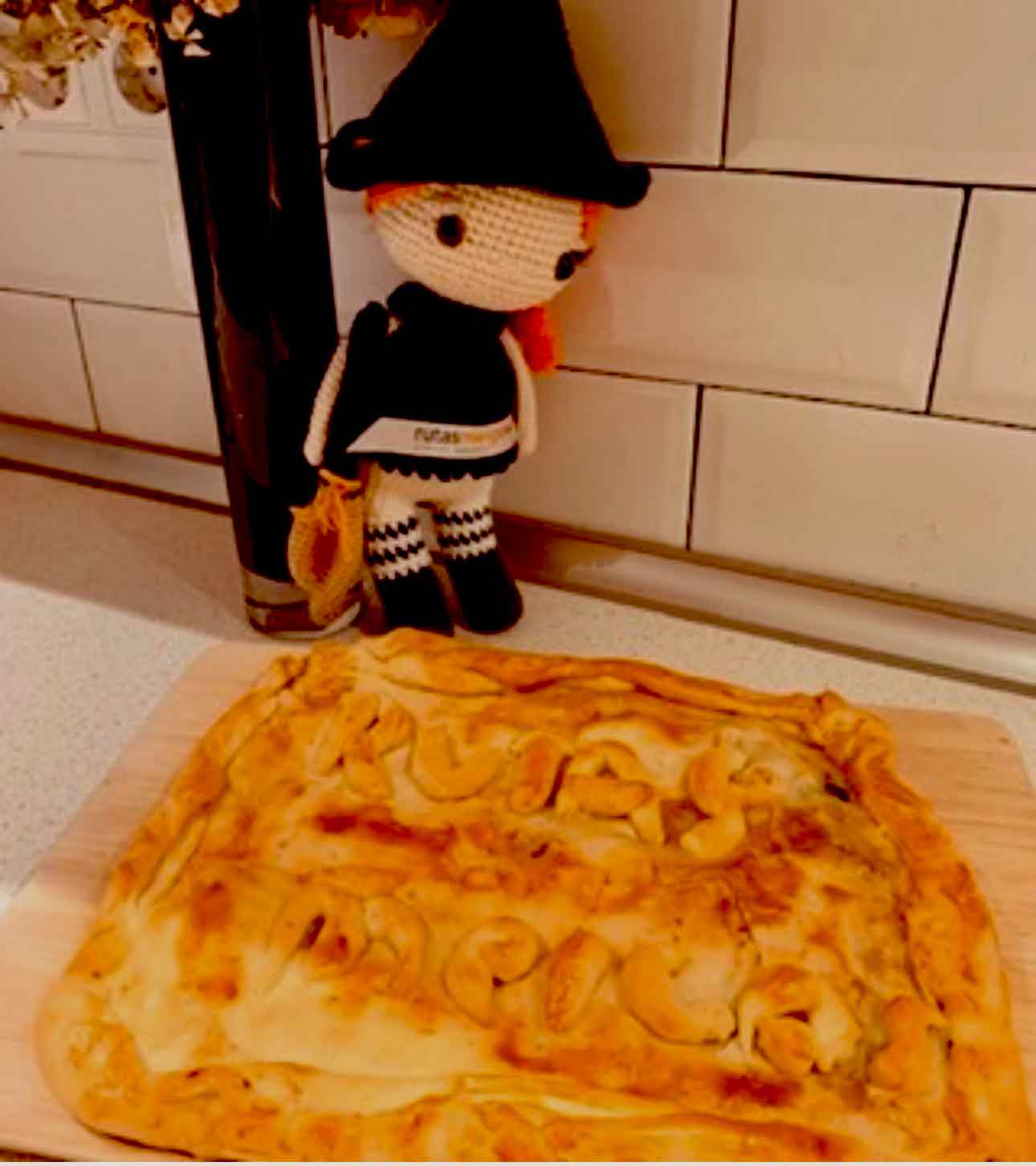
If there’s one dish that sums up the essence of Galician cuisine, it is without a doubt the empanada gallega. Its freshly baked aroma, golden crust, and juicy filling are part of the collective memory of Galicia. It’s hard to imagine a local festival, a village feast, a family gathering, or even a stop along the Camino de Santiago without an empanada on the table.
But the Galician empanada is more than just food. It is history, tradition, a symbol of identity, and a practical meal that has accompanied farmers, fishermen, and pilgrims for centuries. Today, let’s explore the history and secrets of this delicacy that holds a privileged place in the gastronomy of Galicia.
What is a Galician empanada?
Technically, it’s a large savory pie made with thin, crisp bread dough wrapped around a generous filling. And the “generous” part is key when talking about a true Galician empanada.
The dough, traditionally prepared with wheat flour, olive oil, water, and yeast, is carefully stretched until thin enough to turn golden in the oven, but strong enough to hold in the juices of the filling. In some regions, corn flour is used, creating the famous empanadas de millo, typical of the Rías Baixas, often filled with sardines or shellfish like zamburiñas.
The filling is another star. The options are almost endless: tuna, sardines, cuttlefish in their ink, cod with raisins, chicken, zorza (marinated pork), Galician beef, octopus, mussels, cockles… even empanadas made with leftover stew, a brilliant example of Galician resourcefulness. What never changes is the sauté of onions and peppers that adds flavor and juiciness.
Unlike Argentine empanadas, usually small and individual (what in Galicia would be called empanadillas), the empanada gallega is large, made to be sliced and shared. That sharing spirit reflects the very essence of Galicia: hospitality and generosity.
A dish with centuries of history
The exact origins of the Galician empanada are uncertain, but its presence in Galicia is documented as far back as the Middle Ages. Fishermen, travelers, and pilgrims used it as a practical way to carry food. The dough kept the filling safe from road dust and sea air, preserving it for days.
Its importance is even carved in stone. In the 12th-century Pórtico da Gloria of Santiago’s Cathedral, the work of Master Mateo, one sculpture shows a sinner punished as he tries to eat an empanada while a rope tightens around his neck—a warning against gluttony. The carving confirms the empanada’s deep roots in Galician life and its connection to the Camino de Santiago.
In the nearby Pazo de Xelmírez, sculptures of banquets also place the empanada at center stage. The celebrated Galician writer Álvaro Cunqueiro even imagined one of these stone empanadas filled with lamprey.
Empanada in Galician culture and daily life
The empanada gallega is more than a dish—it is culture and community. Traditionally, villages baked large empanadas for patron saint festivals, weddings, and pilgrimages. It was a celebratory food, meant to bring people together.
That tradition lives on. Today, you’ll find empanadas baked in family ovens, artisanal bakeries, and restaurants all over Galicia. It has become one of the most iconic symbols of Galician gastronomy.
It even has its own calendar dates: April’s National Empanada Day and dedicated festivals such as the Festa da Empanada de Bandeira in Silleda, where the best empanadas in Galicia are awarded and auctioned off amid music and celebration.
Fresh ingredients: the secret to the perfect Galician empanada
What makes the empanada gallega unique is its reliance on fresh, local ingredients, a hallmark of Galician cuisine:
- From the sea: sardines, octopus, cod, zamburiñas, mussels, cockles.
- From the land: zorza, chicken, Galician beef, rabbit.
- From the garden: peppers, onions, tomatoes, garlic, forming the indispensable sauté.
- From the mill: wheat or corn flour, each giving its own character to the dough.
Each region of Galicia puts its own stamp on the empanada. A conger eel empanada from A Mariña is very different from a cuttlefish empanada in Redondela or a lamprey empanada in Arbo. This diversity makes the empanada a delicious culinary map of Galicia.
Empanada and the Camino de Santiago: an inseparable bond
The Galician empanada and the Camino de Santiago have been intertwined for centuries. For medieval pilgrims, it was the ideal food: nutritious, portable, and long-lasting.
Legends even say that in the 12th century, pilgrims knew they were nearing Santiago de Compostela when they caught the scent of empanadas baking in nearby villages.
Even today, many pilgrims find the empanada to be one of the best rewards along the Camino de Santiago. Whether it’s a tuna empanada in a small village bar or a pulpo empanada in a Compostela tavern, tasting one is part of the cultural journey—just as essential as visiting the Cathedral or receiving the Compostela certificate.
How to best enjoy a Galician empanada
The empanada is endlessly versatile: it can be the star of a family meal, a starter at a party, a snack during a walk, or a tapa in a local bar.
Tips to savor it fully:
- Eat it warm: freshly baked keeps its crunch, but room temperature is also delicious. It even tastes great the next day.
- Pair it with Galician wines: Albariño or Ribeiro enhance the flavors of the sea.
- Try local specialties: each region offers a different empanada to discover.
- Share it: the empanada is meant to be cut and passed around—it’s social food.
The empanada, a symbol of Galicia
Few dishes can claim such a place in both medieval art and modern festivals, in the daily lives of peasants and nobles, and in the hearts of pilgrims past and present.
The empanada gallega is all that: history, tradition, gastronomy, and culture baked into one recipe. Proof that Galician cuisine can unite simplicity and excellence, humility and greatness.
And if you decide to walk the Camino de Santiago, make sure to taste it more than once—because no two empanadas are ever the same. It will surely be one of the most delicious memories you take home from Galicia.

Comment (0)